
How it's made
From log to leaf, in nine steps.
Every leaf of veneer starts as a log. This is the whole way, step by step.

- 01
Preparation
As soon as the logs arrive, they are kept at the right humidity: soaked in ponds of water, or sprayed, as each one needs.
- 02
Debarking
The bark is peeled off evenly, with great care that the log itself is not damaged.
- 03
Cooking
For an even slice, the logs stay fully submerged in steamers at 80 to 100 °C for 18 to 72 hours, and are cut within an hour of coming out.
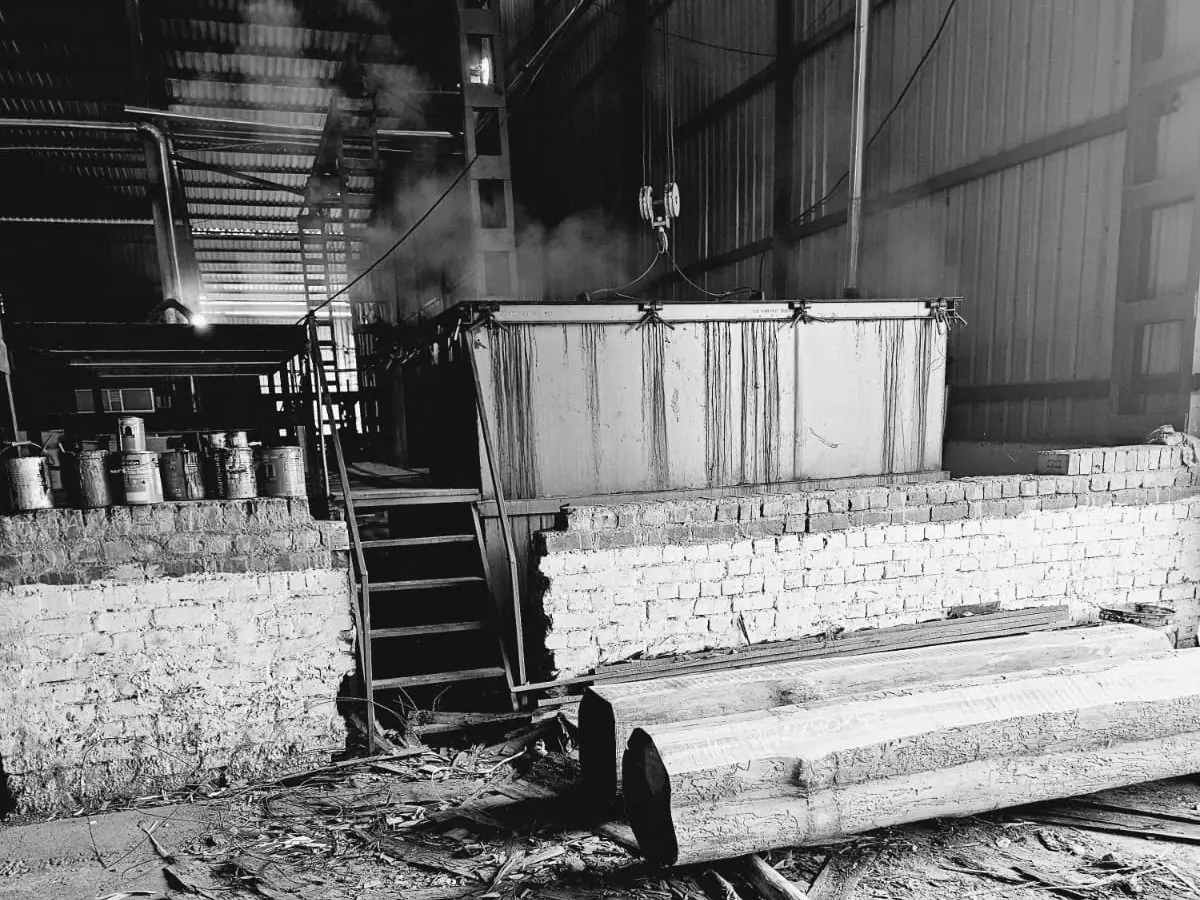
03 · Cooking: logs beside the steamers - 04
Slicing
With the pressure and the knife bar set to an accuracy of 0.1 mm, a slicer or a peeling machine takes thin leaves from the log, while a heating system draws off the moisture it releases. Flat, quarter and rotary cuts give different veneers.
- 05
Drying
The still-damp leaves pass through a jet dryer, which dries them and flattens them at the same time.
- 06
Quality check
An expert looks over the veneers and grades them against strict quality standards.
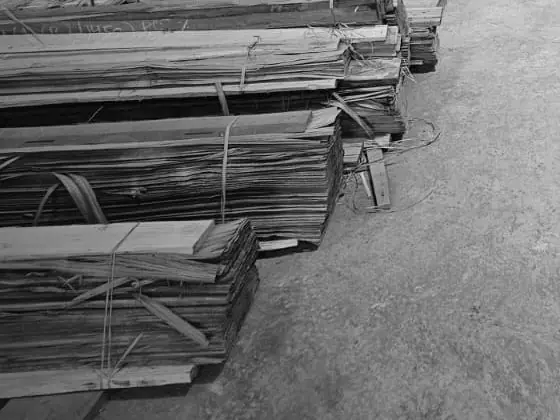
Leaves, bundled - 07
Clipping
The leaves are clipped into clean rectangles, and the glue machine bonds their edges.
- 08
Splicing
Leaves are matched to one another under heat and pressure, so the face is consistent from edge to edge.
- 09
Packing
Finally the veneers are measured, labelled with their length and width, wrapped in protective polythene and readied for the road.
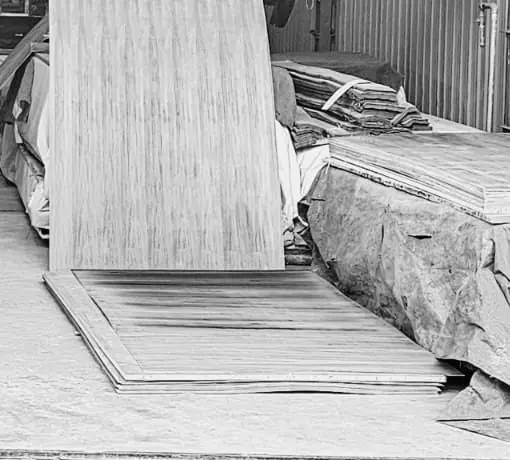
A finished sheet